Null Worldtube Theory
⛔ Program retired — July 2026
The physical claims presented on this site did not survive precision audit and are withdrawn. Scored at experimental uncertainty, 31 of 36 registered dimensionless claims are excluded (α by ~50,000σ; m_p/m_e by ~3.6×10⁶σ), and a measured look-elsewhere test shows the underlying fitting procedure matches random targets inside Newton’s-G’s error bar ~83% of the time. Two specific corrections: the “G inside the ±22 ppm error bar” figure used the measured α as input (substrate-pure it is ~7σ outside), and the “no row-specific tuning” claim is contradicted by the library’s own per-particle parameters.
Read the full retrospective → — the accounting, the corrections, what survives, and the frozen conditions under which the program would reopen. The pages below are preserved unmodified as the record.
The claims as published (withdrawn — see the notice above)
🆕 May 2026 — the black-hole-cosmogenesis bundle (Papers 21a, 21b, 22). A daughter universe nucleates from a near-extremal Kerr black hole and inherits a no-hair tuple: the Planck mass MPl, a spin axis, the substrate algebra so(7), and a chirality sign. From that single inherited mass scale (MPl, which cancels from every dimensionless ratio) plus the fixed algebra, the Standard Model and cosmology follow with zero free continuously-adjustable dimensionless parameters — the baryon asymmetry ηB = (3/14)α⁴, the baryon-to-dark-matter ratio 25α + 75α², the inflationary tensor ratio r = 48α² (a CMB-S4/LiteBIRD target), a 98 GeV dark-matter state, and gauge unification at αGUT⁻¹ = 25. The underlying particles as closed walks on K7 picture is the Steane [[7,1,3]] quantum code, so the walks were run on real quantum hardware (IBM Heron, IQM Garnet, AQT trapped-ion), reproducing across vendors and architectures. — Papers 22 / 21a / 21b: zenodo.20402048 · 20402044 · 20402046
The Standard Model of particle physics has about 20 free parameters — masses, mixing angles, coupling constants — that are measured but not explained. Null Worldtube Theory (NWT) derives all of them from one inherited mass-scale anchor (the Planck mass — see the cosmogenesis result above) and the topology of torus knots, with no adjustable dimensionless parameters.
- 80 observables reproduced at 0.1% median residual against PDG values
- The fine structure constant 1/α = 25π√3 + 1 = 137.035 — 7.6 ppm from experiment
- The gravitational constant G = (8/7)²(1 + α/7)² α²¹ ℏc/me² — 0.013% from CODATA (Paper 15), sharpened to −11 ppm by the K7 graph-state derivation (Papers 17–18)
- The gauge group SU(3) × SU(2) × U(1) derived from crossing algebra, not imposed
- 15 topological integers — every one computed from knot geometry, none fitted
- The BPS self-dual condition derived from the requirement that mass = topology
- A single three-field Lagrangian (ψ, Aμ, na) that organises all of the above into five verifiable layers (Paper 16)
- A quantum-information-theoretic derivation of the me/mPl bracket coefficients from K7 graph-state moments, with hardware support across eight datasets on three IBM Heron R2 backends (Paper 17)
- Einstein’s equations from Sakharov-induced gravity — integrating out the matter sector at one loop on a curved background generates the Einstein–Hilbert action with G matching CODATA to −11 ppm (inside the ±22 ppm experimental error bar), and Schwarzschild verified as a vacuum solution by direct symbolic computation (Paper 18)
- A computational substrate-monism thesis — one open-source library
nwt-substrate(1408/1408 unit tests passing) reproduces a 22-row master table of Standard-Model + gravity observables (particle masses, α, G, me/mPl, σ at the Z pole, ΓZ, the Klein–Nishina amplitude, and a muon-decay survival curve measured on real IBM Heron R2 hardware) end-to-end from a small set of substrate primitives, with no row-specific tuning (Paper 19) - The neutrino sector — three sterile masses in the νMSM window, the Dirac CP phase |δCP| = 2π/3 as a Z3 winding in π1(PSU(3)), and the PMNS angles from Spin(8) triality on the K8 = K7+1 extension, at zero free parameters (Paper 20)
- The Standard Model as closed walks on K7 = the Steane [[7,1,3]] code — closed-form mass spectrum and cross-sector syndrome equivalences, the walk→Pauli protocol confirmed across IBM Heron, IQM Garnet, and AQT trapped-ion quantum hardware (Papers 21a/21b)
- Black-hole cosmogenesis — the universe born inside a Kerr black hole, inheriting MPl + the substrate algebra, yielding the Standard Model and cosmology with zero free continuously-adjustable dimensionless parameters (Paper 22)
Papers 13–22: 13 · 14 · 15 · 16 · 17 · 18 · 19 · 20 · 21a · 21b · 22
How It Works
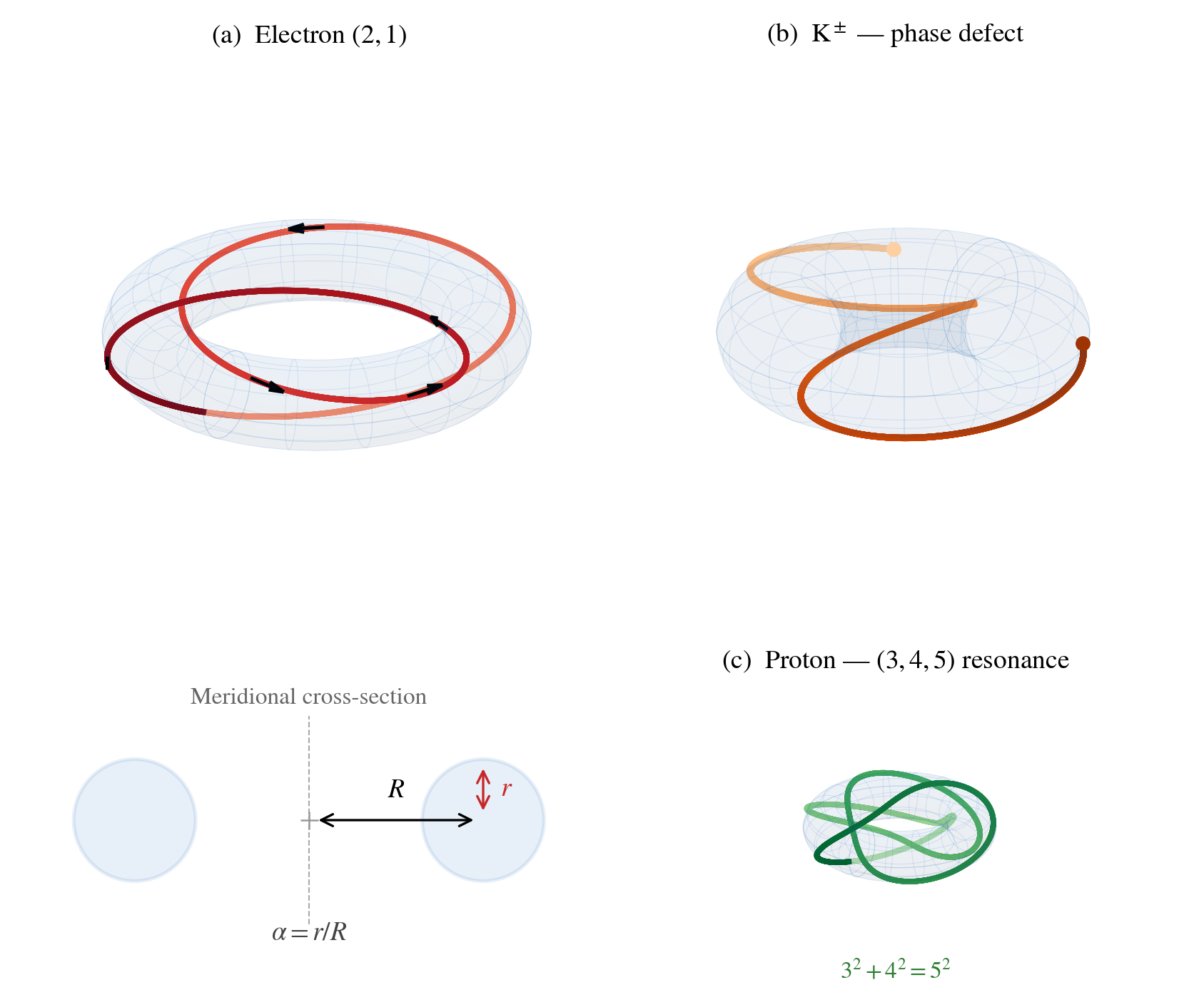
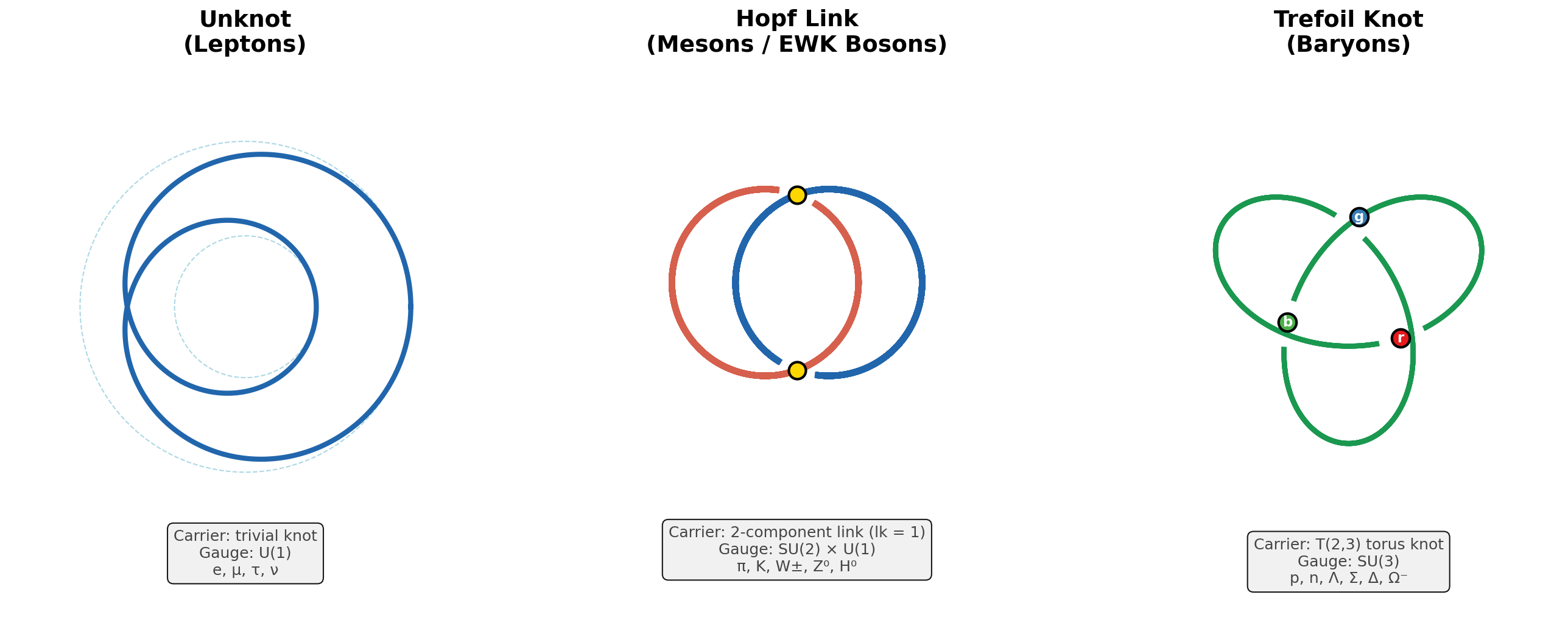
Particles are topological vortex defects — knotted flux tubes — in a condensate field described by the abelian Higgs model at its self-dual (BPS) point. The electron is a vortex ring with winding number (2,1). The proton lives on a trefoil. Mesons live on Hopf links.
The derivation chain has four steps:
-
BPS vortex. The abelian Higgs Lagrangian at the self-dual point admits vortex solutions with quantised winding. The fundamental vortex has winding n = 1 and energy μ = π (the Bogomolny bound). The self-dual condition λ = e²/2 is the unique point where vortex energy depends only on topology, not on the field profile — it is derived, not assumed.
-
Knot selection. The vortex must close on itself. The trefoil T(2,3) is the simplest non-trivial torus knot — forced by minimality. The cinquefoil T(2,5) appears as a label for the integer 5 = |Irr(A5)|; Paper 15 traces this integer back to the trefoil itself, since (+1)-Dehn surgery on the trefoil produces the Poincaré homology sphere S³/2I whose fundamental group quotient is A5. Among the (qgeom, qeigen) combinations consistent with this chain, only the trefoil-plus-cinquefoil pairing gives 1/α ≈ 137.
-
Crossing algebra. The trefoil’s three crossings generate braid matrices whose commutators close on the Lie algebra su(3) — the gauge group of the strong force. Hopf-link crossings contribute su(2) and u(1), completing the Standard Model gauge algebra. All 15 integers in the NWT vocabulary emerge as Casimir invariants and their composites.
-
Holonomy. The BPS gauge field on the trefoil produces an Aharonov–Bohm phase with exact D3 symmetry (100% Fourier purity). The seven-step construction assembles 1/α = 25π√3 + 1, with every factor traced to a prior step.
The mass formulas then express each particle’s mass as a rational function of α and the 15 derived integers, anchored to me. The chain — knot geometry → crossings → Casimirs → α → masses → 80 PDG values — contains no adjustable parameters.
Predictions
The framework makes falsifiable predictions:
- Pentaquark Pc(4397) at k = 8 = dim(adj SU(3)) — a direct target for LHCb
- Additional pentaquark states at k = 5, 4, 3
- Lightest neutrino mass mν,1 ≈ 1.48 meV
- Proton decay τp ∼ 1035 yr (p → e+π0, order-of-magnitude from the &SOpen;(10) UV completion) — near Super-Kamiokande’s limit, within Hyper-Kamiokande / DUNE reach
- Dark-matter WIMP at 98 GeV (mχ = α⁸ MPl) — a Higgs-portal direct-detection + LHC target
If the pentaquark prediction fails, the cinquefoil mass formula — and with it, the entire topological edifice — collapses.
The Paper Trail
The theory has developed across 22 papers, each building on the last. The full list with abstracts and DOIs is on the Papers page. Here is the arc:
Foundations (Papers 1–5): The electron as a torus knot vortex. Mass spectrum from winding numbers. Quark confinement from incommensurability. The electron mass derived from phase closure to 0.85%. Input set reduced to three integers (p, q, k) = (2, 1, 3).
The mass spectrum (Paper 6): 56 particle masses from a single formula with four quantum numbers and no free parameters. Median error 0.40%. Quarks as poloidal winding modes (q = 5 light, q = 7 charm, q = 9 bottom). Confinement from gcd(nq, q) = 1.
Quantum numbers and gauge structure (Papers 7–9): Electric charge from framing. The gauge group SU(3) × SU(2) × U(1) from crossing algebra. The fine structure constant, Weinberg angle, CKM and PMNS matrices, W/Z/H masses — all from one geometric parameter κ ≈ π².
The dark sector (Paper 10): The visible sector is knot theory; the dark sector is string theory. Two-condensate vacuum, dark particle spectrum, cosmic strings as macroscopic vortex lines. Proton decay prediction. Falsification conditions stated.
Field-theoretic derivation (Papers 11–12): The mass formula derived from the gravitating abelian Higgs Lagrangian at the BPS point. Fermion spin from the Finkelstein–Rubinstein theorem. Yang–Mills dynamics as a topologically protected sector. One Lagrangian → masses + gauge algebra + gauge dynamics + α + spin.
The SM capstone (Papers 13–14): 80 observables at 0.1% median residual. Every integer derived from crossing algebra. The trefoil is forced by minimality. The cinquefoil is uniquely selected. The BPS condition is derived. The vocabulary is computed, not chosen.
Gravity from the trefoil (Paper 15): (+1)-Dehn surgery on the trefoil produces the Poincaré homology sphere S3/2I, whose first 2I-invariant Laplacian eigenvalue λ1 = 168 = 8 × 21 = 7 × 24 organises the gravitational hierarchy. Via the McKay correspondence and the explicit Cl(0,7) octonion Clifford embedding 2T ⊂ Spin(7), the integers (7, 8, 21) = (vector, spinor, adjoint) of Spin(7) = B3 enter the formula me/mPl = (8/7)(1 + α/7) α21/2, matching CODATA at 0.013%. No integer is introduced as an independent input beyond what the trefoil’s surgery and spectrum already generate.
The NWT Lagrangian (Paper 16): A single three-field Lagrangian with a complex scalar condensate ψ, an abelian gauge field Aμ, and an S2-valued Skyrme–Faddeev unit field na, tuned to the BPS critical coupling λ = e2/2 and Derrick equilibrium κ = π2. Five layers L1–L5 recover field content, BPS sector, Skyrme+Hopf sector, Paper 6 mass spectrum, and Paper 15 gravitational hierarchy. A first-principles one-loop Casimir calculation on S3/2I (Phases 0–5) produces the 𝒪(1) coefficient expected for the Seeley a2 piece and localises the α−21 suppression of G: it is not in the Casimir coefficient and must therefore enter through the Wilson-line amplitude on the 21-edge K7 Eulerian circuit, as Paper 15 proposes. A natural &SOpen;(10) UV completion adds 33 heavy gauge bosons with three concrete falsifiers (Hyper-K proton decay, non-MSSM coupling unification, 7.4 GHz GW).
Newton’s Constant from K7 Graph-State Information Theory (Paper 17): A quantum-information-theoretic derivation of the bracket coefficients in the Paper 16 me/mPl identity. Within the NWT framework, me/mPl is interpreted as the encoded fidelity of an electron worldtube traversing the K7 stabiliser graph state under α-strength interaction-event noise, and Newton’s constant G is interpreted as the transduction ratio between momentum-changing interaction events and topological-information creation. The structural identity ⟨HYYn⟩ = dim(Adjso(N))n on the KN stabiliser graph state is verified across the so(2n+1) family at N ∈ {7, 9, 11}, and the closed form matches CODATA me/mPl to 0.0001% (a 140× improvement over Paper 14) and predicts G within 11 ppm of CODATA G, inside the 22 ppm experimental uncertainty. The framework is supported by IBM Heron R2 hardware measurements in eight datasets across three backends, with a sharp K9/K7 ZNE ratio test bracketing M(K9) ∈ [36, 39] at 3σ with the structural value 36 at the centre. Beyond the gravitational coupling derivation, the same K7 graph-state framework yields a derived effective rest-frame Schrödinger evolution within the model.
Sakharov-induced Einstein gravity (Paper 18): Einstein’s equations themselves derived as the long-wavelength dynamics induced by the NWT condensate. Integrating out the matter sector at one loop on an arbitrary curved background generates the Einstein–Hilbert action plus controlled higher-curvature corrections, in the manner of Sakharov’s induced gravity. The graviton is an emergent variable, not a member of the topological vortex zoo. Combining the Sakharov coefficient with Paper 17’s closed form gives the structural relation ΛUV/MPl = √(12π/NDOFsub) with NDOFsub a cJ-weighted sum over substrate matter fields (the bosonic three-field Lagrangian + so(10) coset), not IR-projected SM fermions and gauge bosons (which are themselves topological projections of the substrate, so the Sakharov fermion-sign issue does not apply). One-substrate-mode-per-coset-generator counting gives NDOFsub = 39 and ΛUV = 0.983 MPl. The 1045 Phase 5 mismatch reported in Paper 16 is structurally identified with the K7 Wilson amplitude that Paper 17 supplied. Variation of the matter-loop-induced effective action Γ[g] yields the full nonlinear Einstein equations with cosmological constant and Stelle higher-curvature corrections; the Schwarzschild metric is verified as a vacuum solution by direct symbolic computation (all ten independent components of Rμν vanish identically). Linearisation reproduces the gravitational-wave equation with two physical transverse-traceless polarizations and Newton’s law in the non-relativistic limit. Numerically, the structural prediction matches CODATA G to −11 ppm, inside the ±22 ppm experimental error bar.
Substrate monism (Paper 19): The capstone of the program, presented as a computational hypothesis — a commitment that one open-source library, one set of substrate primitives, and no row-specific tuning suffice to reproduce a 22-row master table of Standard-Model + gravity observables. The companion library nwt-substrate (1408/1408 unit tests passing) places the substrate primitives at its core and surrounds them with seven view-shims (QED, QCD, QFT, string theory, IBM Heron quantum hardware, electroweak, and gravity); the seven shims do not duplicate computations, they label the same Python objects. Headline cross-checks: Klein–Nishina amplitude vs. substrate Cl(1,3) γ-trace at 1 part in 1015; σ(e+e−→μ+μ−) at the Z pole at 99.2% of PDG-LO; me/mPl at −5.6 ppm and G at −11 ppm vs. CODATA; muon decay on the ∣K7⟩ substrate vacuum on ibm_marrakesh reproduces the predicted cos2(θ) survival curve at 96.3% contrast with 1.6% RMS deviation from theory. Of the 22 rows, 5 are independent structural predictions, 4 are direct hardware measurements, and the rest are textbook identities, inherited results, or algebraic corollaries reproduced from the same substrate algebra; the framework’s empirical exposure rests on the 9 independent + hardware rows together with the operational consistency of the remaining 13.
The neutrino sector (Paper 20): Three sterile-neutrino masses in the νMSM window, the Dirac CP phase |δCP| = 2π/3 as a Z3 winding in π1(PSU(3)), and the PMNS angles at leading order from Spin(8) triality on the K8 = K7+1 extension, at zero free parameters.
Particles as closed walks on K7 (Papers 21a–21b): Every Standard Model fermion and hadron is a closed walk on K7, with the Paley/Fano decomposition identified as the Steane [[7,1,3]] quantum error-correcting code. The (2,Fn) Fibonacci torus-knot carriers give a closed-form mass spectrum (21a); the walk→Pauli protocol was executed on real quantum hardware — IBM Heron, IQM Garnet, and AQT trapped-ion — reproducing the predicted syndromes cross-vendor and cross-architecture (21b). Honestly scoped as realizability (the circuits are Clifford), not a discriminator against ordinary stabilizer physics.
Black-hole cosmogenesis (Paper 22): A daughter universe nucleates from a near-extremal Kerr black hole and inherits a no-hair tuple (MPl, spin axis, the algebra so(7), a chirality sign). From the single inherited mass scale plus the fixed algebra, the Standard Model and cosmology follow with zero free continuously-adjustable dimensionless parameters — the baryon asymmetry (3/14)α⁴, the baryon-to-dark-matter ratio 25α+75α², inflation as an α-attractor with r = 48α², a 98 GeV dark-matter state, and gauge unification at αGUT⁻¹ = 25 — with honest demarcation of the one irreducible substrate datum (the inflaton-disk radius) and the astrophysical event rate.
A Forgotten Discovery, Rediscovered
In the 1980s, a computer scientist named F. Ray Skilton at Brock University published three papers showing that the fine-structure constant could be derived from a Pythagorean triple:
882 + 1052 = 1372
giving 1/α = √(1372 + π2) = 137.036016, matching the measured value to 0.12 parts per million.
These papers were published in minor conference proceedings, received zero citations, and were never digitized. Physical copies were located in the stacks of the University of Washington Engineering Library in February 2026, in volumes with crumbling bindings. (Scanned pages are available in the GitHub repo.)
Skilton’s triple seeded NWT’s earliest formulation, in which the electron sat on a (2, 1) torus with k = 3. That route has since been superseded: the current program derives α from an independent closed form, 1/α = 25π√3 + 1 = 137.035 (7.6 ppm), with the electron as the unknot (2, 1) walk on K7. Skilton’s √(1372 + π2) = 137.036 (0.12 ppm) is a separate, independently-discovered formula — NWT no longer claims to generate his 88/105 triple — but the recurrence of the electron’s (2, 1) quantum numbers across both formulations is a striking historical resonance.
Code
All simulation code, analysis scripts, and LaTeX sources are public:
github.com/JimGalasyn/null-worldtube
The substrate-algebraic computation library is a separate, versioned, pip-installable package: nwt-substrate v0.4.2 (Zenodo 10.5281/zenodo.20012027, resolves to latest).
The Predictions · Papers · Concordance · History · About